
Starting a skincare brand is exciting, but it also comes with its own set of challenges. One of the most important decisions you will make is choosing the right manufacturing partner for your products. You want high-quality formulations without the significant costs associated with building and operating your own production facility. This is where an OEM skincare manufacturer plays an important role. This guide explains what an OEM skincare manufacturer does and how it helps brands bring skincare products to market efficiently and successfully.
The beauty industry has experienced rapid growth in recent years, with more entrepreneurs launching their own collections of creams, cleansers, and serums. However, producing skincare products requires specialised equipment, technical expertise, and stringent testing procedures. Partnering with an experienced manufacturer allows brands to overcome these challenges while maintaining product quality and regulatory compliance.
What Does OEM Mean in Skincare?
OEM stands for Original Equipment Manufacturing. Although the term may sound technical, the concept is relatively simple. An OEM company manufactures products that are sold under another brand’s name. You provide the product concept, packaging design, and marketing strategy, while the manufacturer manages the formulation and production processes.
1. Focus on Building Your Brand
OEM skincare partners transform your ideas into finished products that are ready for retail distribution. This allows you to focus on building your brand while experienced professionals manage the technical aspects of manufacturing. There is no need to invest in specialised equipment, hire formulation chemists, or establish your own laboratory facilities.
2. Utilize Their Existing Resources
Manufacturers already possess the facilities, technology, and expertise required for skincare production. An OEM skincare manufacturer in Singapore can provide these services to both local entrepreneurs and international brands. At the same time, you retain complete ownership of your brand identity, product concepts, and packaging designs.
How the Manufacturing Process Works?
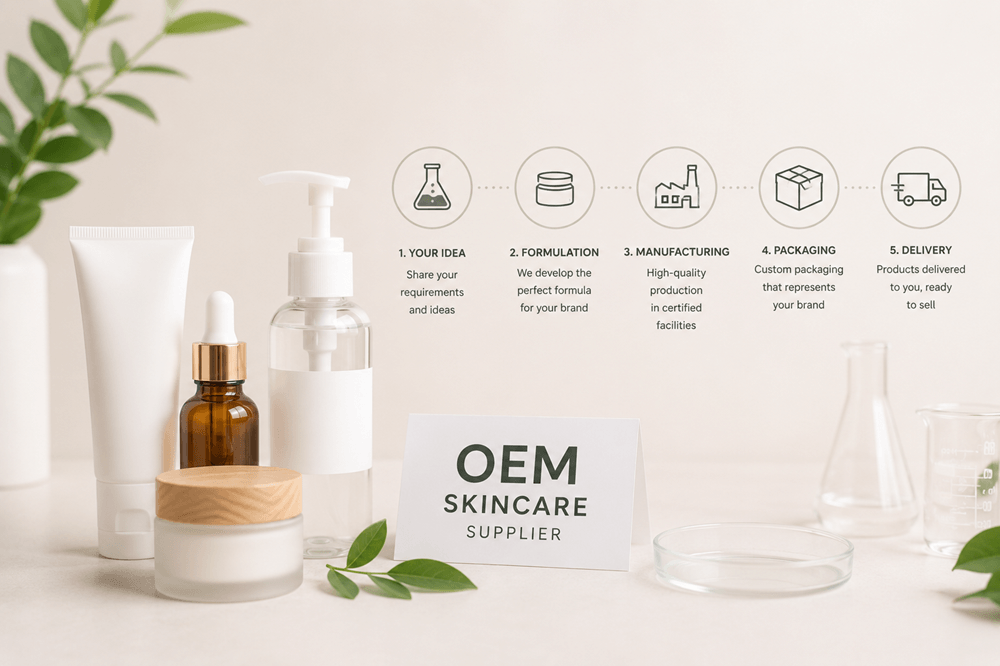
Transforming an idea into a finished skincare product involves several carefully managed stages. The process begins with discussing your product vision and requirements with the manufacturing team. They will guide you through selecting existing formulations or developing a completely customized product. A Skincare OEM manufacturer often maintains an extensive portfolio of formulations that can be customized to suit your brand.
- During the initial consultation, you will share your objectives, target market, and product specifications. The manufacturing team will provide recommendations based on your budget, timeline, and desired product characteristics.
- The next step involves selecting an existing formulation or developing a product from scratch. Existing formulations can often be customized by incorporating specific ingredients or adjusting the product’s texture and consistency.
- Small sample batches are then prepared for evaluation and approval before full-scale production begins. This allows you to test the product thoroughly and request refinements until it meets your expectations.
- Once the formulation receives final approval, the manufacturer sources the required raw materials and begins large-scale production. They oversee every stage of the process, including mixing, filling, packaging, and comprehensive quality control procedures.
Why Partner with an OEM Manufacturer?
Building your own skincare manufacturing facility requires a substantial financial investment and may take years to establish. Partnering with an OEM manufacturer eliminates these significant costs while accelerating your time to market. OEM skincare partnerships allow brands to launch products within months rather than years.
1. Save Significant Costs
You pay only for the products being manufactured rather than investing in expensive equipment and facilities. This allows you to allocate more resources towards marketing, brand development, and business growth. Partnering with an OEM manufacturer provides a cost-effective pathway to entering the skincare industry.
2. Benefit from Industry Expertise
Experienced manufacturers provide valuable technical knowledge that would otherwise require considerable time and investment to acquire independently. An OEM skincare manufacturer in Singapore adheres to stringent manufacturing and safety standards that protect both your customers and your brand reputation. Their expertise also helps minimize costly production and compliance mistakes.
Custom Formulations Versus Private Label Products
When working with manufacturing partners, brands generally choose between two approaches. Private label manufacturing involves selecting existing formulations that are already produced by the manufacturer. Your brand label is then applied to a proven product. This option offers a faster and more affordable route to market.
- Private label manufacturing provides significant time savings because the formulations have already undergone testing and validation. Brands can often launch products within weeks instead of several months.
- It also requires a lower upfront investment, as formulation development costs are largely eliminated. This makes private label manufacturing particularly attractive for first-time brand owners.
- Custom formulations provide complete control over the ingredients, performance, and sensory experience of your products. A Skincare OEM manufacturer works closely with your brand to develop exclusive formulations tailored specifically to your requirements.
- Custom development also provides greater protection against competitors replicating your products. Although the process requires more time and investment, it delivers a truly distinctive product offering.
Quality Control and Safety Testing
As skincare products are applied directly to the skin, safety remains a critical priority for every brand. Reputable manufacturers follow strict quality control procedures to ensure products are safe, effective, and consistently manufactured. Every production batch undergoes testing for bacteria, mound, and other contaminants before distribution.
1. Testing Every Production Batch
OEM skincare partners conduct comprehensive stability testing to assess how products perform over time. These tests expose formulations to varying environmental conditions to simulate transportation and storage environments. Stable products maintain their texture, color, and fragrance throughout their intended shelf life.
2. Preventing Product Contamination
Without appropriate testing procedures, skincare products may separate or develop microbial contamination without visible signs. Your manufacturer should provide certificates of analysis for every production batch to confirm compliance with all required safety standards.
Packaging Options and Customization
Packaging plays an important role in communicating your brand’s identity and creating a memorable customer experience. Your manufacturing partner can provide standard packaging solutions or assist in developing customized designs. OEM skincare manufacturers typically offer extensive catalogues of bottles, pumps, jars, and tubes for selection.
- Choose standard packaging options from available catalogues when seeking cost-effective and efficient solutions. The manufacturer manages component sourcing and inventory requirements on your behalf.
- Custom packaging solutions provide distinctive branding opportunities that help products stand out within competitive retail environments. This option is particularly valuable for brands seeking stronger visual differentiation.
- Manufacturers can also provide labelling and assembly services to simplify supply chain management. An OEM skincare manufacturer in Singapore frequently offers these value-added services to improve operational efficiency.
- Managing both formulation and packaging through a single manufacturing partner also reduces coordination challenges and streamlines communication throughout the production process.
Building a Long-Term Manufacturing Partnership
Choosing the right manufacturing partner involves more than comparing prices and production capabilities. Successful OEM skincare partnerships are built on trust, effective communication, and aligned business objectives.
1. Visit the Manufacturing Facility
Whenever possible, visit the manufacturer’s facility to observe their production processes and meet the team responsible for your products. Seeing their operations firsthand provides valuable insight into their capabilities, quality standards, and commitment to excellence.
2. Review Their Track Record
Ask about their existing client relationships and how long they have partnered with other brands. Long-standing partnerships often indicate consistent product quality and reliable customer service. Pay attention to how they respond to questions, requests, and potential challenges during your initial discussions.
Conclusion
Working with an OEM skincare manufacturer provides a practical and efficient pathway to launching your skincare brand. OEM skincare partnerships allow manufacturers to manage complex production processes while enabling brands to focus on marketing and business growth. You avoid the substantial costs associated with building a manufacturing facility while benefiting from established expertise and production capabilities.
Private label solutions provide a lower-risk option for testing market demand, while custom formulations allow brands to develop distinctive products that stand apart from competitors. Comprehensive quality control procedures and safety testing protect both consumers and your brand’s reputation. Flexible packaging options further support your brand’s positioning and market objectives.
An OEM skincare manufacturer in Singapore offers these comprehensive services to entrepreneurs and businesses ready to enter the beauty industry. Through Skincare OEM partnerships, innovative product ideas can be transformed into high-quality skincare products ready for commercial success.
Frequently Asked Questions (FAQ)
An OEM skincare manufacturer develops customized formulations exclusively for your brand, while private label suppliers provide existing formulations that may be shared across multiple brands. OEM manufacturing offers greater product differentiation, whereas private label manufacturing provides faster and more cost-effective market entry.
Custom skincare product development typically takes between four and six months. This timeline includes formulation development, stability testing, packaging selection, and full-scale production. Products containing specialized active ingredients may require additional development time.
You should request batch testing certificates, stability test reports, complete ingredient listings, manufacturing licenses, and relevant regulatory documentation. Maintaining these records helps ensure your products comply with applicable industry requirements.
Yes. Many manufacturers offer lower minimum order quantities specifically designed for emerging brands. Minimum production quantities often range from 500 to 1,000 units, depending on the product category and formulation requirements.
It is advisable to sign a non-disclosure agreement before sharing proprietary information with your manufacturer. Reputable manufacturers typically include confidentiality provisions within their agreements, ensuring that your custom formulations remain your intellectual property and are not supplied to competing brands.